
The Dangote Playbook: 10 Business Principles for Building an Empire.
Discover The Dangote Playbook: practical business principles inspired by Aliko Dangote's approach to industrialization, manufacturing, scale, and long-term wealth creation. Learn how to identify business bottlenecks, build competitive advantages, and turn opportunities into scalable enterprises.
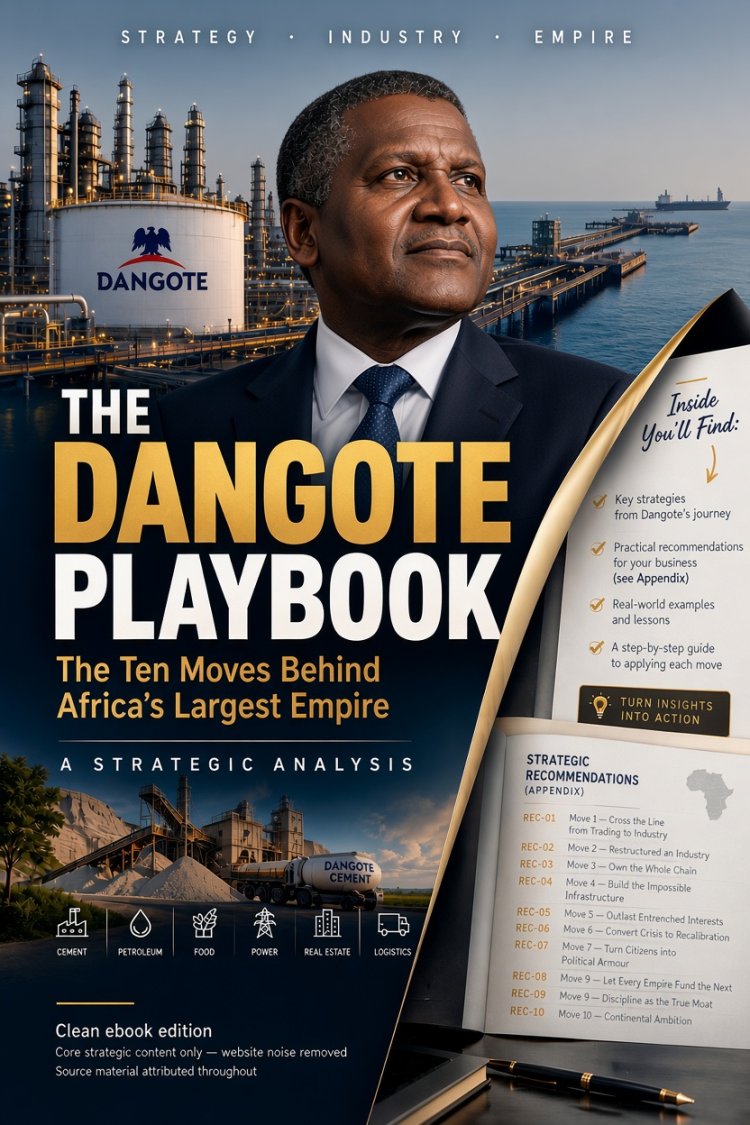


DELIVERABLE 1: FINAL ARTICLE
The Dangote Playbook: How to Find the Bottleneck That Builds a Business
Most people study Aliko Dangote by looking at his wealth. A more useful question is what he chose to build when trading was easier.
In the 1990s, Dangote ran one of Nigeria's largest trading operations, moving commodities like cement, sugar, flour and salt. According to The Dangote Playbook, margins in pure trading were thin and depended heavily on forex allocation, permits and tariff policy. Trading was profitable. It was also exposed to forces the trader could not control.
This article explains what the book argues, tests its ideas against the evidence (including the criticism), and gives you a method you can use this week.
In this article
What is The Dangote Playbook?
Beyond wealth: why the system matters
Four principles that matter most
The Bottleneck Method
Applying this in Nigeria and Africa
A 15-minute exercise
Common mistakes
Explore the full book
FAQ
What Is The Dangote Playbook?
The Dangote Playbook: The Ten Moves Behind Africa's Largest Empire is an independent strategic analysis, not an authorised Dangote Group publication. It breaks Dangote's business journey into ten "moves," then converts each into a practical recommendation (REC-01 to REC-10).
What makes it unusual is how it handles evidence. Every claim is tagged as a fact, an attributed quote, a company claim, the author's interpretation, or counter-evidence. That lets you see what is verified and what is argument.
The book also states a caveat most success stories skip: Dangote began with family trading capital and later operated with significant access. Its lessons are distilled for readers without those advantages.
Beyond Wealth: Why the System Matters
Wealth is an outcome. The system that produced it is the lesson.
The book's core contrast is between a trader and an industrialist. In its words, a pure trader rides policy weather, while an industrialist tries to change the climate by locking capital into plants that must keep running whatever the policy mood. That is the book's interpretation, but it points at something real: businesses differ in how much of their fate they control.
Notice that the book does not treat Dangote as infallible. For nearly every move it includes counter-evidence. Cement is the clearest case. Nigeria's market is widely described as an oligopoly, and the book cites reports of sharp retail price rises in 2023–2024. A barrier that protects a successful first mover can also keep prices high for consumers. Both things can be true.
Four Principles That Matter Most
1. Run the numbers before you leave a flexible model
The principle: Move from trading or activity into production only when the full cost comparison justifies it.
The fact it rests on: The book reports that in the late 1990s and early 2000s, importing cement was more profitable in the short run than producing it. Public reports it cites put local output at roughly 1.7–2 million tonnes a year, against demand several times higher.
Why it matters: Production means higher capital needs, longer payback and less flexibility. The book argues that accepting those costs created a barrier that pure traders could not easily climb.
How to apply it (REC-01): Compare the full landed cost of buying in against the full cost of making it yourself, including energy, logistics, finance, downtime, taxes and working capital. Do it for one high-frequency product only, with best, base and stress cases.
Where it fails: Under-used capacity destroys value. The book is clear that manufacturing is not automatically superior to trading.
2. Redesign the incentive, not the rhetoric
The principle: When behaviour conflicts with a long-term goal, change what makes the behaviour profitable.
The example: The book describes a widely reported exchange between Dangote and President Olusegun Obasanjo about why Dangote imported cement rather than making it. Versions attribute to him a line that importing was more profitable than producing. Secondary sources treat this as the origin of Nigeria's cement Backward Integration Policy. The book notes it did not isolate primary cabinet minutes, so treat the exact wording as reported, not confirmed.
How to apply it (REC-02): Define the outcome you want and the behaviour blocking it. Then make the incentive measurable and time-bound, with independent verification. Inside a small business, tie rewards to outcomes rather than activity.
Where it fails: The same episode can be read as regulatory capture: a dominant trader helping write rules that favoured the investment he was positioned to make. The book warns against building a model that survives only on special arrangements.
3. Own only the critical bottlenecks
The principle: Control the links in your chain that most threaten reliability, margin or access. Contract the rest.
The example: The book describes a model that includes limestone reserves, power generation, packaging, large truck fleets and, later, dedicated petroleum logistics. Its interpretation: a competitor can build a modern plant, but without reliable movement of product the plant sits isolated.
How to apply it (REC-03): Map your chain. Score each link by the cost of failure against the cost of owning it. Prefer contracts and a second supplier where you can.
Where it fails: Over-integration locks up capital and can trigger conflict. The book points to 2025 disputes between NUPENG and the Dangote Refinery over driver unionisation, with the union alleging anti-labour practices. For a small business, a reliable supplier plus one backup often beats ownership.
4. Protect the core before you expand
The principle: Release cash for the next project only after operations, debt service, maintenance and reserves are covered.
The example: The book notes the sequence of cement funding fertiliser, then the refinery. It also records a warning sign: in August 2024, Fitch Ratings downgraded Dangote Industries Limited to B+(nga) from AA(nga), citing liquidity deterioration, naira devaluation and missing 2023 audited accounts. Fitch recorded an FX loss of NGN 2.7 trillion in 2023 and noted the refinery ran at about 50% capacity in the first half of 2024.
How to apply it (REC-08): Define "safe cash" first. Set milestones and expected returns for each new project, and stop projects that miss their gates.
Where it fails: Targets are not results. The book separates large forward ambitions from demonstrated free-cash-flow capacity, and so should you.
The Bottleneck Method
The book's ideas become most useful when turned into a repeatable method. This one is my synthesis of its themes (REC-03, REC-04, REC-09), not a framework the book names itself.
A bottleneck is the single constraint that limits how much value a system can deliver.
Identify the constraint. Where does work queue up, spoil or stall?
Investigate why it exists. Is it cost, skill, regulation, infrastructure or habit?
Find who bears the cost. If nobody pays, nobody will buy the fix.
Estimate the value of removing it. Put a naira figure on it.
List the resources required. Money, people, permits, time.
Test willingness to pay. Sell before you build.
Measure results. Use a few indicators.
Find the next constraint. It will appear.
Illustrative example (hypothetical): A small tomato-paste processor in northern Nigeria loses a share of each harvest to spoilage before processing. The constraint appears to be cold storage, but investigation shows the real problem is transport time from farms to the plant. Farmers bear the loss. The processor tests a cheaper fix first, a shorter collection route with covered crates, before considering a cold room. Revenue per tonne improves, and the next constraint becomes packaging supply.
The lesson is in the order. The expensive "obvious" fix was not the first one tried.
Why removing a bottleneck is not a guaranteed profit: The book's own cautions apply. A real problem can be too small, too slow to monetise, or solved cheaper by someone else. It also warns that company-reported mega-project figures are claims until audited, and that infrastructure should be staged so each phase proves demand (REC-04). For example, the book cites a water-treatment capacity of 110,040 m³/day for the Dangote refinery from the contractor WABAG, and flags an earlier circulated figure as unverified. Even in a famous project, numbers need checking.
Applying This in Nigeria and Africa
Nigeria's conditions shape which opportunities are viable. Consider five factors:
Purchasing power. A product can be needed and still unaffordable at the price your costs require.
Infrastructure. Unreliable power and roads can be the constraint, or the business.
Currency risk. The book stresses FX shocks. If you import inputs and sell in naira, a devaluation hits your margin directly.
Financing and working capital. Growth can run out of cash before it runs out of customers.
Regulation. Rules differ across African countries. The book warns that a large addressable market is not a profitable operation in each jurisdiction (REC-10).
A responsible path: Start with one manageable opportunity and a paid test of demand. Define kill criteria in advance. Prove local unit economics, then expand deliberately. Do not treat "Africa" as one market.
A 15-Minute Exercise: Find One Problem Worth Investigating
Take paper or a notes app and answer these in writing:
Name one recurring problem that costs a business or household money in your area. (3 min)
Who pays the cost, and roughly how much per month? (2 min)
Why does it persist? Name one constraint, not three. (3 min)
Who already tries to solve it, and why is that not enough? (2 min)
What is the smallest paid test you could run in seven days? (3 min)
What result would make you stop? Write a number. (2 min)
Your output is one sentence: "I will test [solution] with [customer] by [date], and stop if [result]."
Common Mistakes to Avoid
Copying a founder without their conditions. The book itself notes Dangote's capital and access. Your starting point differs.
Confusing revenue with profit. Volume that loses money on every unit is a faster route to failure.
Expanding before validating demand. Under-used capacity is the book's repeated warning.
Ignoring working capital. Build a simple 13-week cash view (the book recommends one).
Mistaking a big problem for a profitable one. Pain does not equal willingness to pay.
Buying equipment before demand exists. Rent, share or partner first.
Treating persistence as evidence. The book's advice is to commit to the goal but change the method when evidence demands it.
Explore The Dangote Playbook
If you want the full framework, the book covers:
The ten moves told as one continuous narrative
Ten recommendations (REC-01 to REC-10) with how-to-apply steps, risks and small-scale versions
A summary matrix of each move's biggest risk if misapplied
A "Build Your Dream" practical guide for limited capital
A book map for problems you will meet next
A verification log and end checklist
It does not promise outcomes, and neither do I.
[https://selar.com/4d2414liob]
Frequently Asked Questions
What is The Dangote Playbook?
An independent strategic analysis of ten moves behind Dangote's business journey, with evidence labels, counter-evidence and practical recommendations. It is not an authorised company publication.
What can entrepreneurs learn from Aliko Dangote?
According to the book: weigh production economics before leaving trading, align incentives, own only critical bottlenecks, and protect the core before expanding. It also teaches what to watch for, including governance and liquidity risks.
How do I apply these ideas to a small business?
Pick one product, compare buy-versus-make costs with a stress case, and run a small paid test. The book's small-scale versions favour reliable capacity plus one backup over ownership.
How do I identify a profitable opportunity?
Look for a recurring problem that costs someone money, understand why it persists, and confirm that the payer will actually pay for a fix.
What is a business bottleneck?
The one constraint that limits how much value a business or supply chain can deliver.
How should I approach manufacturing in Nigeria?
Model power, logistics, FX and working capital explicitly. Start with a pilot or committed buyers, and survive 12–18 months of lower prices and slower sales before committing (REC-01).
Where can I get the book?
[]
Conclusion: Turn Inspiration into Investigation
Do not ask "How do I become Dangote?" Ask "What constraint, if removed, would unlock the most value for someone who will pay for it?"
This week: choose one problem, name its constraint, and run one paid test with a stop rule. Then write down what you learned.
DELIVERABLE 2: PUBLISHING METADATA
Title: The Dangote Playbook: How to Find the Bottleneck That Builds a Business
Slug: the-dangote-playbook-bottleneck-method
Meta description (about 155 chars): Learn the ideas in The Dangote Playbook, test them against the criticism, and use a simple bottleneck method to find your next business opportunity.
Primary keyword: The Dangote Playbook
Secondary topics: Aliko Dangote business strategy; lessons from Dangote; how to identify business opportunities; business bottlenecks; manufacturing in Nigeria; scaling a business in Nigeria
Tags: Dangote Playbook, Aliko Dangote, Business Strategy, Entrepreneurship, Nigeria, Manufacturing, Bottleneck
Main image filename: dangote-playbook-ten-moves-ebook-cover.jpg
Alt text: Cover of The Dangote Playbook ebook showing a refinery, cement plant and the title "The Ten Moves Behind Africa's Largest Empire"
Category / subcategory: Business / Entrepreneurship (or Books / Ebooks if available)
DELIVERABLE 3: INTERNAL-LINK PLAN
Title: How to Run a Buy-vs-Make Cost Comparison for a Small Business
Intent: How-to
Anchor: "run the numbers before you leave a flexible model" (The Dangote Playbook)
Title: What Is a Business Bottleneck? Examples from Nigerian Industries
Intent: Informational
Anchor: "The Bottleneck Method"
Title: 13-Week Cash Flow Template for Nigerian Small Businesses
Intent: Template or tool
Anchor: "13-week cash view" (The Dangote Playbook)
Title: Why Cement Prices Matter: Market Structure and Consumer Cost in Nigeria
Intent: Analysis
Anchor: "counter-evidence in The Dangote Playbook"
Title: How to Test Demand Before Building: A 7-Day Paid Test
Intent: How-to
Anchor: "smallest paid test of demand"
None of these exist yet.
DELIVERABLE 4: SOURCE LIST
Originates from the uploaded PDF (the book's framework, REC-01 to REC-10, summary matrix, Build Your Dream guide, verification log) and is attributed as such in the article.
Facts the PDF itself cites (I did not re-verify these independently in this session, and I have not included links I did not retrieve):
Fitch Ratings rating action commentary, 5 Aug 2024 (also Reuters and Bloomberg coverage, 6 Aug 2024)
WABAG project page, Dangote Refinery water solution (110,040 m³/day)
Legit.ng price surveys and New Telegraph market-share discussion (cement prices and oligopoly)
Businessday and court reporting on NUPENG disputes (2025)
My own contributions: the Bottleneck Method framing, the tomato-paste example (hypothetical), the 15-minute exercise, and the Nigeria and Africa considerations.
What's Your Reaction?